How ColorMyMath works
A number is a quantity you can see — that many dots, always in its own color. Everything on this site is built on that one idea. Here it is in pictures.
1 · The problemChildren learn the squiggles before the quantities.
Most children can say "seven" and write a 7 long before they know what seven is. The squiggle isn't seven. It's a name for seven, and a child who only has the name is memorizing, not understanding — which is why 8 + 5 can be "known" on Friday and gone on Monday.
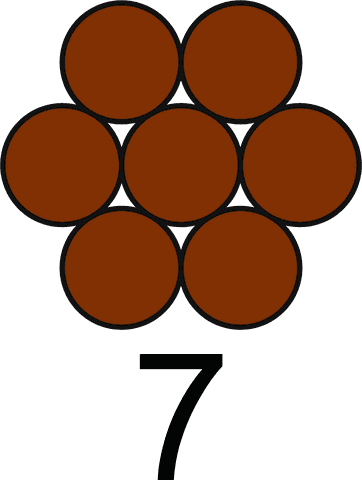 seven
Workbooks make it worse in a way that is easy to miss. To fit a number line or a counting box on the page, they shrink the objects as the numbers get bigger. Two apples get a whole box; nine get crammed into the same box. Look at that page with a child's eyes and the 9 is the smaller thing.
The workbook page
ColorMyMath
2 · Visible quantitiesShow the amount, and the child can reason about it.
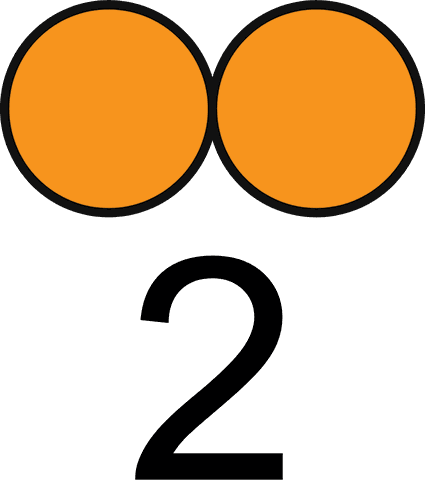
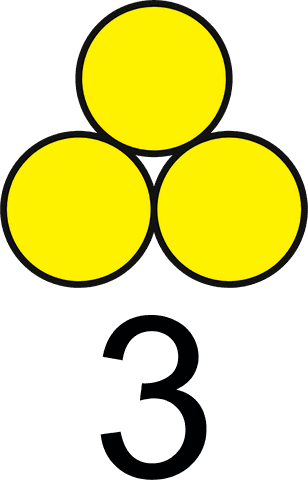
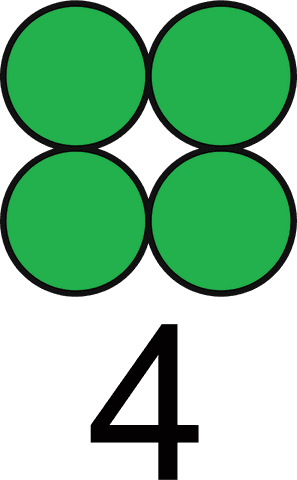
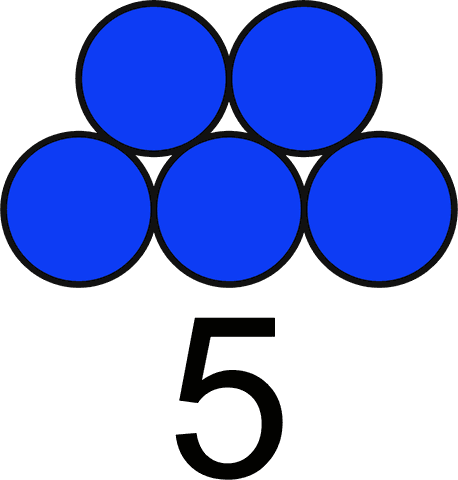
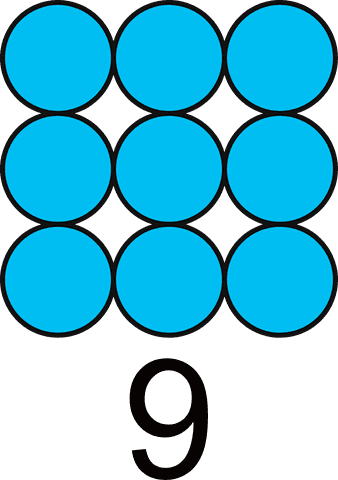
On every page here a number is drawn as that many dots. The dots touch, each one has a heavy black outline so it stays countable, and they never shrink to fit. The numeral sits underneath, as a label — never instead of the dots.
A child who can see five can compare it with seven, take one away, or split it into two and three, before they can read a single digit. The reasoning comes first; the symbols are attached to something they already understand.

3 · Consistent colorEvery digit keeps its color, everywhere.
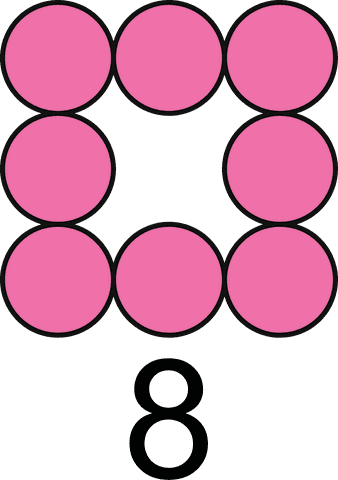
One is always red. Two is always orange. Three is yellow, four green, five blue, six purple, seven brown, eight pink, nine sky blue — in every game, book and printable. A child stops reading the color and starts knowing it, the way you know a stop sign without reading the word.
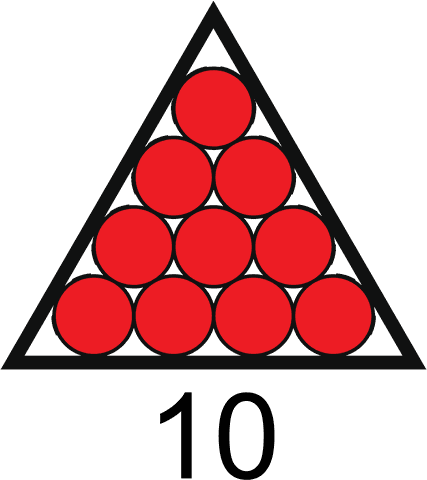
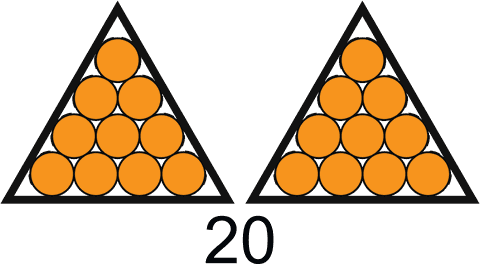
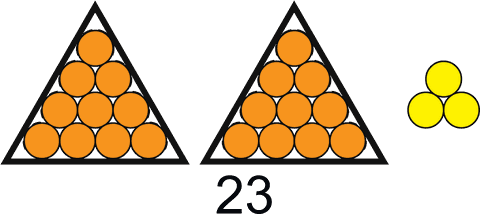
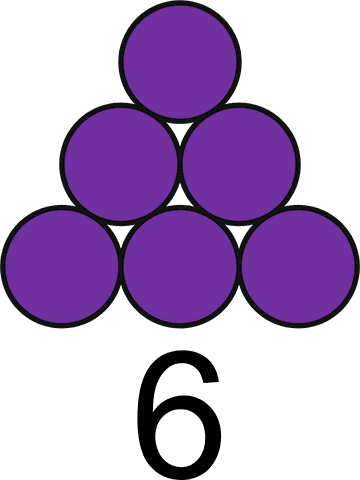
That pays off at place value. 1 and 10 share red. 2 and 20 share orange. A ten is ten dots gathered into one triangle, and the triangle takes the color of the tens digit — so the number of triangles is the tens digit.
Each quantity also has a fixed shape. Three is always a triangle; four and nine are always squares. After a while a child sees "four" at a glance instead of counting one, two, three, four.
4 · BuddiesWhy making 10 comes first.
There are only five pairs that make ten — we call them buddies: 9 and 1, 8 and 2, 7 and 3, 6 and 4, 5 and 5. Laid out as dots, each pair is the same length: one ten.
Learned early and by sight, the buddies carry almost everything after them. The hard addition facts become easy: 8 + 5 is 8, plus 2 (8's buddy) to reach ten, plus the 3 left over — 13. Taking away is the same move backwards: 13 − 9 is a jump down to the ten, then 9's buddy. Later the same idea makes 100 (60 + 40) and works with any ten. That is why the games ask for them before anything harder, and why every game asks both ways: 7 + ? = 10 and 10 − 7.
5 · The ladderAdding is length. Times is area. Cubes are volume.
The same dots grow up with the child, one dimension at a time. Nothing is thrown away and relearned: each new operation is the picture before it, turned a new direction.
Adding
3 + 4 is a line seven dots long. Take the four away and three are left — the same line, read the other way.
Jump Down →Times
3 × 4 is a rectangle: three rows of four. Turn it and it is four rows of three. Share the 12 into rows and you are dividing — one rectangle, both ways.
Turn the Block →Cubes
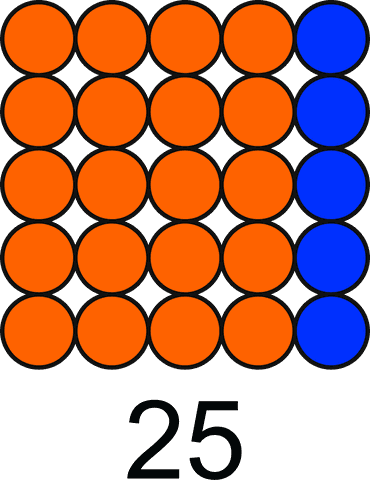
Stack three squares of nine and you have a cube: 3 × 3 × 3 = 27. Squares and cubes stop being words and become shapes you can build.
Build the Cube →The rectangle and the cube are colored by row and by layer — red, orange, yellow — so a child reads "three groups" without counting.
6 · At homeA few games a day.
Everything is free, with no account and nothing to install. Picture first, speed last: let your child play with the dots long before anyone times them.
Where Do I Start?
A short check that finds the first thing your child doesn't know yet and starts
them there. No marks, no pass or fail.
Today's four games
On the front page every day: one game your child already knows, to warm up, then
the next three they haven't played. Then it stops — come back tomorrow.
Progress and a certificate
What your child has played, what comes next, and a certificate to print with
their name. Kept on your device only.
7 · In classEvery standard, a free game.
The curriculum runs in 85 steps, from counting to five up to squares, cubes and Pythagoras, and each step is matched to the standards it teaches. Teachers can look up a code and go straight to a game for it.
 Math standards, K–8
Every Common Core / Massachusetts standard from Kindergarten to grade 8, each with
the game that teaches it. Find a code like K.CC.B.6 or 3.OA.C.7 and play.
 The Massachusetts mapping
Every step of the curriculum matched to the Massachusetts Curriculum Framework
for Mathematics (2017), with the grade each step belongs to.
 Printables
Free worksheets in color: count and write, color the dots, make 10, bigger and smaller. A new sheet every time.
An honest note. ColorMyMath is a teaching approach. It has not been through a controlled study, and we don't claim test-score results for it. What we can say is that every idea on this page is something you can see for yourself in a few minutes with your own child.